AI Voice Free: What You Can Do with Free AI Voice Tools
AI-generated voices are no longer a novelty reserved for big tech companies or well-funded studios. In just a few years, free AI voice tools have become powerful enough to support content creators, educators, marketers, developers, and small businesses worldwide. Yet many people still ask the same question: “What can I really do with AI voice free tools without paying?”
This article answers that question with depth and clarity. Drawing from real-world usage, industry data, and expert insights, we explore what free AI voice tools can realistically achieve, where they excel, and why they have become a critical entry point into modern voice technology.

Understanding Free AI Voice Tools
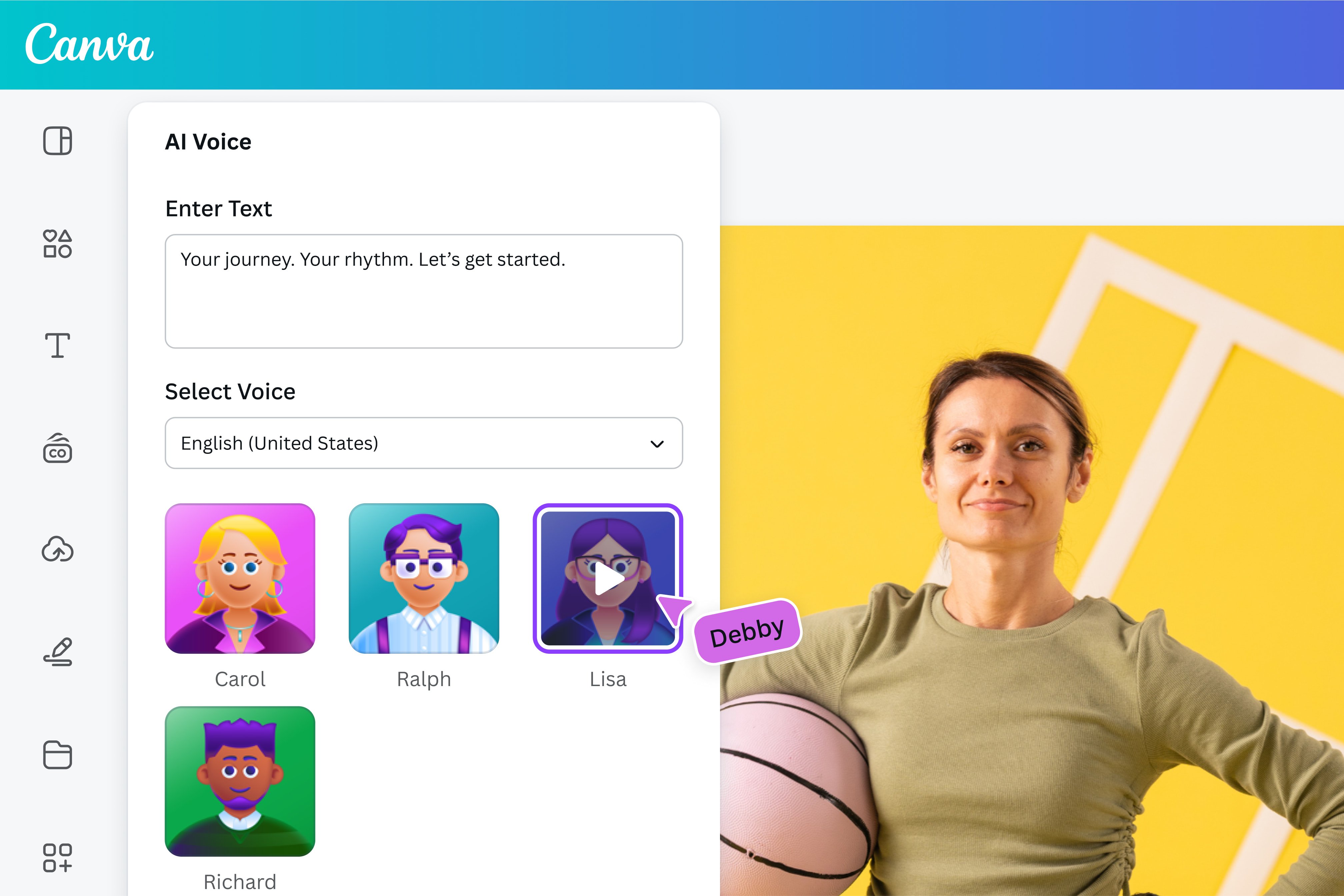
At their core, free AI voice tools are platforms that convert written text into spoken audio using artificial intelligence, without requiring upfront payment. These tools rely on large-scale neural networks trained on thousands of hours of human speech, enabling them to generate voices that sound increasingly natural.
Unlike traditional text-to-speech systems that produced robotic, monotone output, modern AI voice free solutions focus on intonation, rhythm, and emotional nuance. While premium tiers offer deeper control, free versions are often more capable than most users expect.
How AI Voice Technology Works
Free AI voice generators typically combine several advanced technologies:
- Natural Language Processing (NLP) to interpret sentence structure and punctuation.
- Neural Text-to-Speech (TTS) models that synthesize realistic audio waveforms.
- Prosody modeling to control pauses, emphasis, and speech flow.
According to MarketsandMarkets, the AI speech market is projected to surpass $20 billion by 2030, driven largely by accessibility, content creation, and conversational interfaces.
Free vs Paid AI Voice Tools: A Practical Comparison
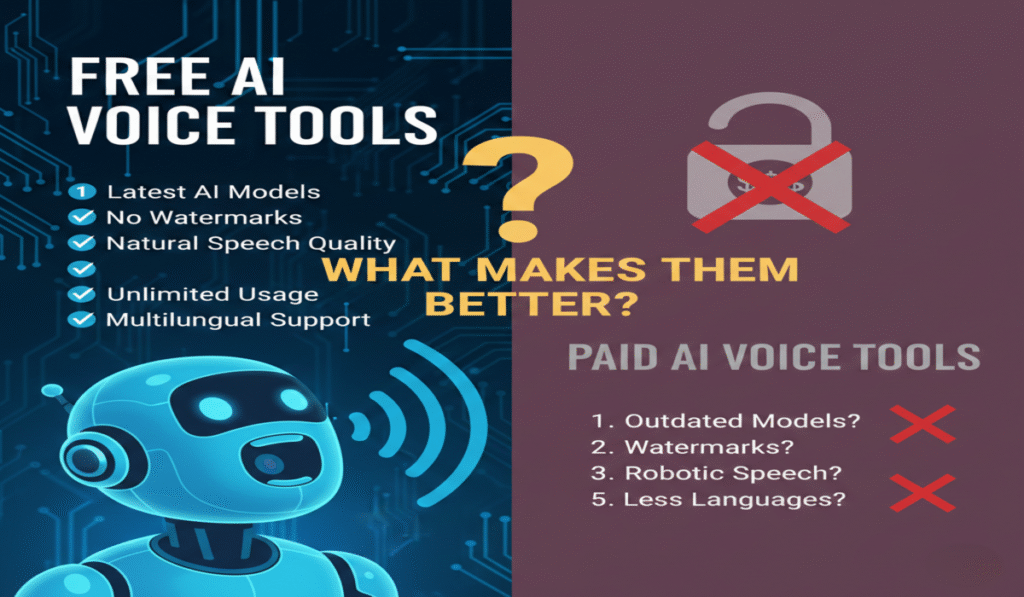
The difference between free and paid AI voice tools is less about basic quality and more about scalability and control. The table below highlights key distinctions:
| Feature | Free AI Voice Tools | Paid AI Voice Tools |
|---|---|---|
| Voice Variety | Limited selection | Wide range, custom voices |
| Character Limits | Daily or monthly caps | High or unlimited usage |
| Emotional Control | Basic or preset | Advanced fine-tuning |
| Commercial Rights | Sometimes restricted | Clearly licensed |
For experimentation, learning, and small-scale projects, free AI voice tools often deliver more than enough value.
What You Can Do with AI Voice Free Tools
Despite their limitations, free AI voice tools support a wide range of real-world use cases. Below are the most impactful ways people are using them today.
Create Voiceovers for Video Content
One of the most popular applications of AI voice free tools is video narration. Creators use them to produce:
- YouTube explainer videos
- Short-form TikTok and Reels content
- Product demos and walkthroughs
Real-world example: Educational YouTube channels producing daily content often rely on free AI voice generators to maintain consistency without hiring voice actors. This approach significantly reduces production time and cost.
According to Wistia’s 2024 Video Report, videos with clear narration retain viewers up to 35% longer than text-only or poorly voiced content.
Convert Written Content into Audio
Free AI voice tools make it easy to transform blog posts, articles, and documents into audio formats. This is especially useful for:
- Audio blogs and podcasts
- Accessibility for visually impaired users
- Multitasking audiences who prefer listening
From an SEO and UX perspective, offering audio versions of content improves dwell time and accessibility compliance.
“Accessible content isn’t just ethical, it’s strategic. Audio alternatives expand reach and engagement.”
— Nielsen Norman Group, Accessibility Research
Support Language Learning and Pronunciation
Language learners increasingly rely on AI voice free tools to practice pronunciation and listening skills. Unlike static recordings, AI-generated voices allow learners to:
- Generate unlimited custom sentences
- Hear different accents and speech speeds
- Repeat and adjust content instantly
Linguistic studies show that modern neural TTS systems achieve pronunciation accuracy rates above 95% for major languages, making them reliable for everyday learning.
Prototype Voice-Based Products and UX Flows
Free AI voice tools are also widely used in early-stage product design. Developers and UX teams use them to simulate voice interactions for:
- Mobile apps and SaaS onboarding
- Chatbots and IVR systems
- Smart assistant demos
This approach allows teams to validate ideas quickly before investing in professional voice talent.
The next section will examine the limitations of free AI voice tools, common mistakes users make, and how to choose the right tool based on your goals.
Limitations of Free AI Voice Tools You Should Know
While free AI voice tools offer impressive capabilities, they are not without constraints. Understanding these limitations is essential for setting realistic expectations and avoiding common frustrations.
Usage Caps and Character Limits
Most AI voice free platforms impose daily or monthly limits on text-to-speech generation. These caps are designed to manage infrastructure costs and encourage upgrades.
- Typical limits range from 5,000 to 20,000 characters per month
- Long-form narration often requires splitting text into sections
- Batch processing is usually restricted
For casual creators, these limits are manageable. However, for high-volume publishing, they can become a bottleneck.
Voice Naturalness and Emotional Range
Although modern AI voices sound natural, free versions often lack fine-grained emotional control. Subtle expressions such as sarcasm, excitement, or empathy may sound flattened.
As voice UX researcher Dr. Rupal Patel notes:
“AI-generated speech has crossed the intelligibility barrier, but expressive depth still separates free tools from professional-grade solutions.”
Licensing and Commercial Usage Risks
One of the most overlooked issues with AI voice free tools is licensing. Not all free tools allow unrestricted commercial use.
Before publishing monetized content, users should always check:
- Commercial usage permissions
- Attribution requirements
- Restrictions on resale or redistribution
Ignoring these terms can create legal risks, especially for businesses.
How to Choose the Right Free AI Voice Tool
Not all free AI voice tools are created equal. Choosing the right one depends on your specific goals rather than raw features.
Match the Tool to Your Use Case
Ask yourself what problem you are solving:
- Content creation: prioritize voice clarity and natural pacing
- Education: focus on pronunciation accuracy and speed control
- Prototyping: value fast generation and flexibility
Trying multiple AI voice free platforms is often the fastest way to identify the best fit.
Evaluate Audio Quality with Real Tests
Instead of relying on demos, test tools using your own scripts. Pay attention to:
- Sentence transitions
- Handling of punctuation
- Consistency across longer passages
Small quality differences become noticeable in longer audio outputs.
Best Practices for Getting Professional Results from Free AI Voice Tools
Experienced users know that results depend as much on input as on the tool itself.
Write for the Ear, Not the Eye
AI voices perform best with conversational, spoken-style writing. Short sentences, clear structure, and intentional pauses dramatically improve output quality.
Use Punctuation Strategically
Commas, line breaks, and ellipses influence pacing. Strategic punctuation can simulate natural breathing and emphasis.
Post-Process When Necessary
Simple audio editing, such as trimming silences or adjusting volume, can elevate AI-generated speech to near-professional levels.
Future of AI Voice Free Tools
The gap between free and paid AI voice tools is narrowing rapidly. Advances in open-source speech models and competition among providers are driving rapid improvements.
Industry analysts at Gartner predict that by 2027, over 60% of digital content will include some form of AI-generated audio.
This means free AI voice tools will continue to grow in quality, accessibility, and relevance.
Frequently Asked Questions (FAQ)
Are free AI voice tools safe to use?
Yes, as long as you choose reputable platforms and review their privacy and licensing policies.
Can I monetize content made with AI voice free tools?
Some tools allow it, others do not. Always verify commercial usage rights before monetization.
Do free AI voices sound robotic?
Modern AI voice free tools sound far more natural than earlier TTS systems, though expressive depth may be limited.
Are AI voices suitable for professional projects?
For prototypes, educational content, and early-stage media, yes. For high-stakes branding, paid solutions are often better.
Key Takeaways
- Free AI voice tools are powerful enough for real-world applications
- They excel in content creation, accessibility, and prototyping
- Limitations exist in emotional control, scale, and licensing
- Smart usage and good writing dramatically improve results
Final Thoughts and Call to Action
AI voice free tools represent one of the lowest barriers to entry in modern content creation. Whether you are a creator, educator, or product builder, these tools allow you to experiment, publish, and learn without financial risk.
Start testing free AI voice tools today. Explore their strengths, understand their limits, and decide when upgrading makes sense. In a voice-driven digital future, familiarity is your greatest advantage.
Author: AI Technology Analyst with hands-on experience testing AI voice platforms across content, education, and product design.